

Milestone Concept
The “HOW”?
Framework for real progress toward Net Zero
The Milestone Concept: A transparent, practical, and scientifically vetted approach to measuring decarbonization progress without relying on distant targets, third-party pathways or assumption-based forecasts. Using a simple yet robust scoring system, it measures real decarbonization progress — namely the decoupling of CO₂ emissions growth from traffic growth. Agnostic to airlines’ underlying business models, it enables meaningful peer comparisons while remaining as resilient to greenwashing as possible.
Designed for integration into finance and leasing contracts, it is equally suitable for measuring the decarbonization progress of lessors‘ and financiers‘ aviation portfolios.
The Milestone Concept allows stakeholders to:
- Replace unclear assumption-heavy decarbonization pathways with a simple and clear metric, which truly measures progress in decarbonization
- Incentivize transition through integration into loan and lease agreeements
- Track risk exposure and portfolio alignment over time

The Practitioner’s Guide 1.0 provides guidance on integrating the Milestone Concept into aviation transactions. The Guide evolves as the industry and scientific findings e.g. on non-CO₂ effects emerge.
The Great Decoupling of air traffic and emissions trends
The “WHY”?
impact’s approach to decarbonize aviation
“Air traffic grows faster than fuel efficiency” – Aviation is committed to Net Zero emissions by 2050. But the continuing rise in air traffic means aviation emissions are growing faster than the rate at which technology is reducing aircraft’s carbon footprint. These countervailing trends drive the “sustainability conundrum” aviation needs to tackle: As long as efficiency gains remain too small to offset the effect of air-traffic growth, CO₂ emissions will continue to rise as passenger and cargo volumes do.
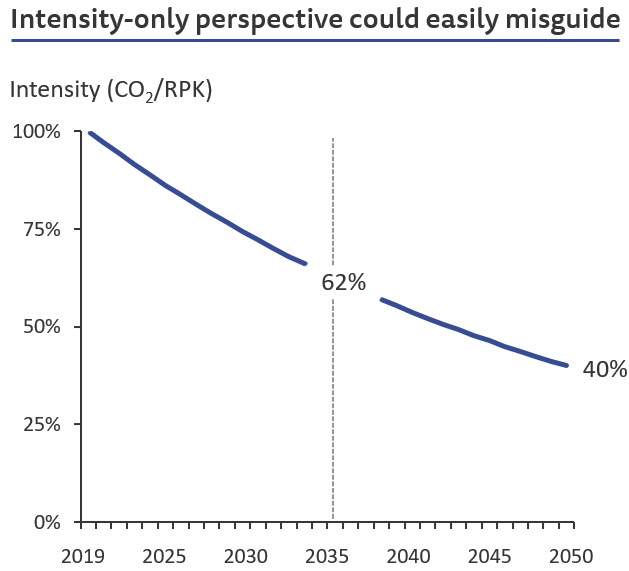
This is why impact wants aviation to decouple emissions trends from air-traffic growth – so that eventually CO₂ volumes decline even as air traffic keeps growing. A focus on emissions intensity (CO₂/RPK) – a metric which has historically shown improvements -is likely to disguise overall emissions trends which continue to rise.
Transparency is key to decarbonization of the airline industry. Therefore, impact‘s focus lies on measuring the decoupling of aviation‘s CO₂ emissions from the industry‘s economic output.
A meaningful approach will ascertain long-term availability of capital
impact suggests to substitute assumption-heavy and thus potentially unstable forecasts as reference yardsticks in loan or lease agreements. Instead, impact proposes using different levels of increasingly difficult-to-achieve thresholds for a simple and transparent scoring system (“Milestones”). Milestones are defined by categories of capacity growth and decarbonization. Once an airline has accomplished a particular Milestone, its sustainability score rises accordingly. Read more on the methodology of the Milestone Concept.
No assumptions or forecasting models are required to set appropriate Milestones, the rules are fully transparent, and the thresholds remain constant until 2050. The concept of Milestones is analytically sound, scientifically vetted and easy to understand, interpret and implement.